UNDERSTANDING FACIAL AGING
Laura Masini, JetPeel by TavTech Global Educator
ABSTRACT
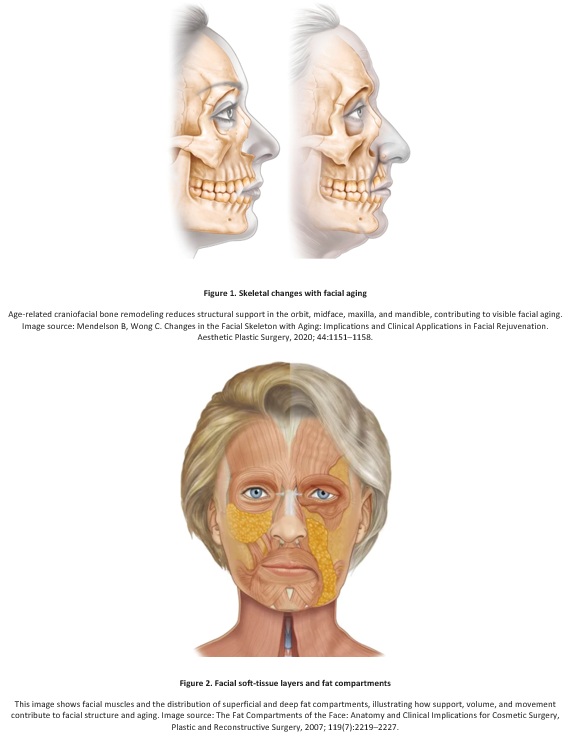
Facial aging is a progressive, multidimensional process, where gradual remodeling of bone, soft tissues, fat compartments, and muscle dynamics alters facial support and mechanical balance. This “inside-out” process precedes visible surface manifestations. As structural support and biological efficiency decline, the skin’s capacity for repair and adaptation is reduced. The visible signs of facial aging represent the combined effect of structural remodeling, mechanical stress, biological changes, and environmental influences acting together.
INTRODUCTION
Facial aging can be described as a gradual weakening of the system that supports and stabilizes the face. As this support becomes less efficient, facial tissues struggle to manage the forces created by everyday movement and gravity.
When support is reduced, mechanical stress is no longer evenly distributed. Instead, it concentrates within the soft tissues and at the skin surface, where recovery is slower and less effective. Over time, this leads to visible changes such as reduced firmness, tissue laxity, and wrinkle formation, which reflect functional adaptation to increased mechanical strain rather than isolated skin problems.
DIMINISHED SKIN QUALITY
Diminished skin quality develops as a direct consequence of facial aging, as progressive structural remodeling reduces the support system underlying the skin. Changes in bone structure, connective tissue stability, and biological efficiency weaken facial support, altering how mechanical forces generated by movement and gravity are distributed.
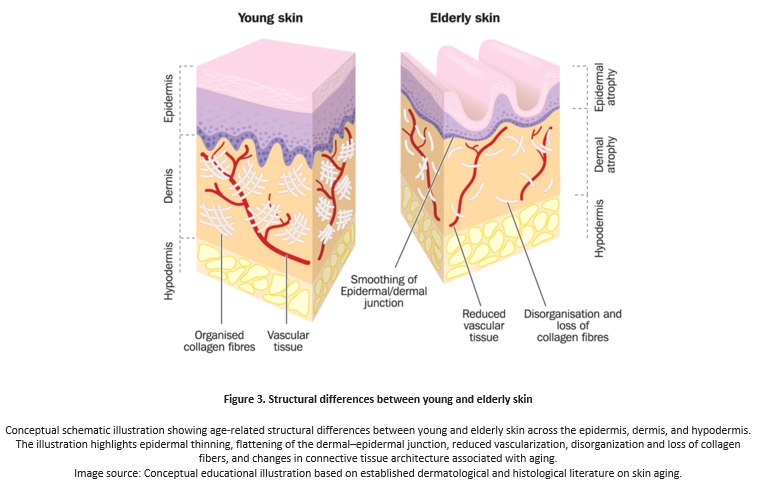
At the same time, the skin’s intrinsic capacity to adapt and regenerate decreases. The progressive degradation of collagen, elastin, and hyaluronic acid, together with changes in facial fat compartments and underlying bone support, reduces tissue resilience and recovery potential. Clinically, this results in reduced radiance, uneven texture, and visible signs of cutaneous fatigue or stress.
INCREASED SOFT TISSUE LAXITY
Increased soft tissue laxity develops as facial support gradually weakens with aging. As connective tissues lose strength and elasticity, the face becomes less able to maintain firmness and stability. As this support system declines, facial tissues are less efficient at absorbing movement and returning to their resting position. Although facial muscles continue to move throughout life, tissue recovery after contraction becomes slower and less effective.
Mechanical stress therefore accumulates within the tissues instead of being released over time. Clinically, this process appears as reduced firmness and tone, lower tissue density, and visible laxity, which often becomes more noticeable during fatigue or prolonged facial activity. These changes reflect a gradual loss of functional tissue tension associated with facial aging.
FORMATION OF RHYTIDES (WRINKLES)
Rhytides develop as a direct consequence of facial aging, as the skin progressively loses elasticity, structural support, and regenerative capacity. Repeated facial movements generate mechanical stress that, in youthful skin, can be absorbed and released.
With aging, reduced collagen and elastin integrity limits this recovery, allowing mechanical forces to become progressively fixed along lines of movement. Clinically, this process appears first as fine lines, followed by dynamic wrinkles during expression and, over time, static wrinkles visible at rest. Wrinkles therefore reflect the cumulative effect of repeated mechanical stress acting on skin with diminished repair efficiency.
VOLUME REDISTRIBUTION OR DEFLATION
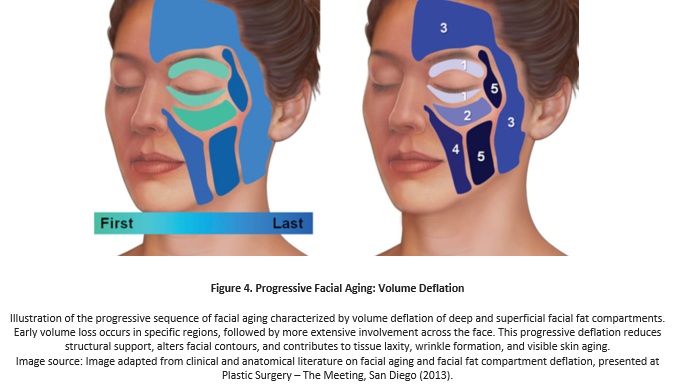
Volume redistribution or deflation results from progressive structural remodeling associated with facial aging rather than uniform tissue loss. Bone resorption reduces the internal scaffold supporting soft tissues, while deep fat compartments lose stabilizing function and superficial fat becomes more mobile under gravitational influence.
These changes alter facial mechanical balance, leading clinically to deflation in some areas and relative fullness in others, with altered contours and proportions. Volume redistribution often accentuates laxity and wrinkles, contributing to a more fatigued or aged facial appearance.
NON-INVASIVE SUPPORT FOR CUTANEOUS ADAPTATION DURING STRUCTURAL FACIAL CHANGE
As facial aging progresses, structural remodeling increases mechanical stress on the skin and reduces its regenerative and repair capacity. This leads to diminished skin quality, tissue laxity, wrinkle formation, and volume alteration.
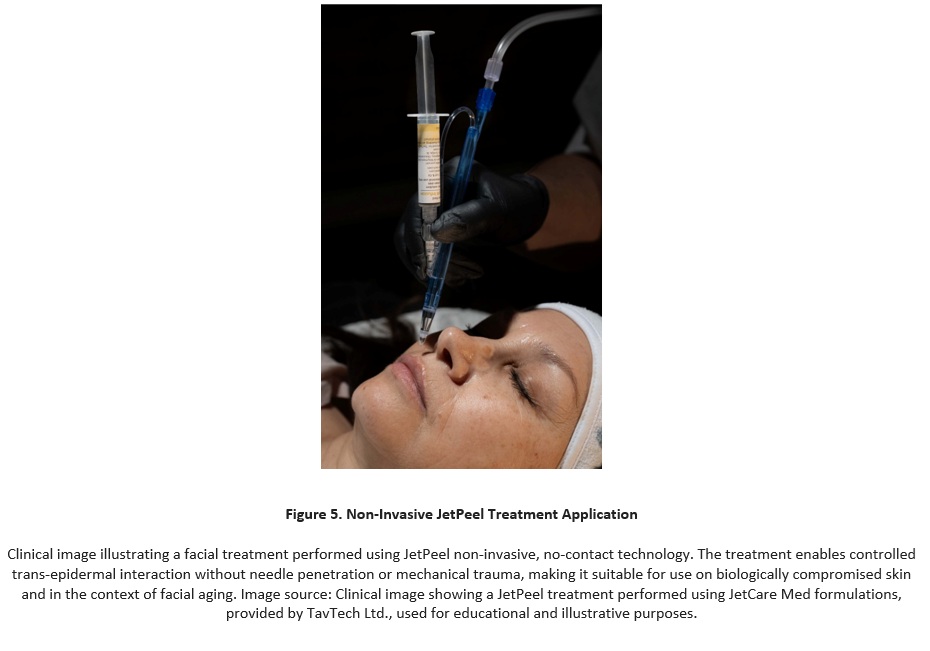
Environmental stressors further accelerate these changes by impairing hydration, protein stability, and extracellular matrix function. Within this context, JetPeel by TavTech represents a non-invasive, non-contact approach specifically suited for biologically compromised and aging skin. When combined with JetCare Med by TavTech formulations enriched with osmolytes, it actively supports skin hydration, a fundamental requirement for maintaining biological efficiency in aging tissues, while invigorating collagen and elastin, protecting peptides, and stabilizing proteins at a time when protein degradation and functional decline are increasingly prominent.
By preserving hydration and protein integrity without introducing mechanical or inflammatory burden, this non-invasive strategy supports skin quality, tissue elasticity, and overall skin function. It assists the skin’s capacity to adapt to progressive structural facial change and persistent environmental stressors, reinforcing functional balance rather than attempting surface-level correction.
CONCLUSION
Facial aging results from the progressive interaction between structural remodeling, mechanical forces, and functional adaptation across all facial layers. The skin is the final interface where these cumulative changes become visible.
Understanding surface alterations within this integrated anatomical and biological process allows non-invasive approaches to be positioned realistically—not as corrective solutions, but as supportive strategies that respect tissue integrity and functional balance. Within this context, JetPeel by TavTech represents a non-invasive treatment that supports cutaneous function and homeostasis during structural facial change, assisting adaptation without adding mechanical or inflammatory stress.