
TRANS-EPIDERMAL WATER LOSS (TEWL):
THE PRIMARY DRIVER OF SKIN DEHYDRATION
Laura Masini, JetPeel by TavTech Global Educator
ABSTRACT
Skin hydration is essential for epidermal structure, barrier integrity, and normal cellular function and depends on the skin’s ability to retain water while limiting surface water loss. Trans-epidermal water loss (TEWL) is the continuous, passive diffusion of water through the epidermis toward the external environment and represents the primary mechanism by which cutaneous water is lost under physiological conditions (due to the natural difference in water content between the skin and the surrounding air).
In healthy skin, TEWL remains low due to an intact epidermal barrier. When barrier integrity and cutaneous water-retention capacity are compromised, TEWL increases, leading to skin dehydration and progressive impairment of epidermal barrier function.
INTRODUCTION
Skin hydration is regulated by the coordinated function of the stratum corneum, epidermis, and dermis. The stratum corneum limits passive water evaporation, epidermal keratinocytes regulate intracellular and intercellular water balance, and the dermis provides a continuous water source that supports upward water movement.
Disruption of these systems (due to reduced barrier efficiency or environmental stress) results in increased trans-epidermal water loss (TEWL), reflecting early impairment of epidermal barrier function and reduced cutaneous resilience.
SKIN HYDRATION AND TRANSEPIDERMAL WATER LOSS
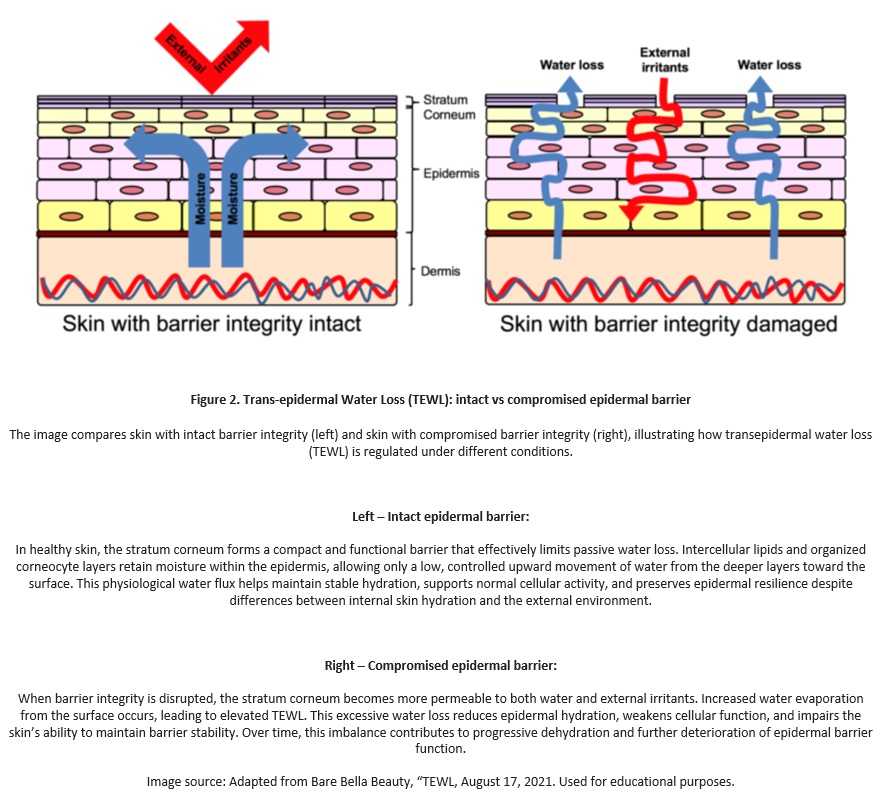
Skin hydration and trans-epidermal water loss (TEWL) are closely linked and function as an integrated system that maintains skin stability and resilience. Physiological skin hydration depends on the ability to retain water within the skin while allowing a controlled, continuous loss at the surface. A low, constant level of water loss is normal due to the semi-permeable nature of the skin.
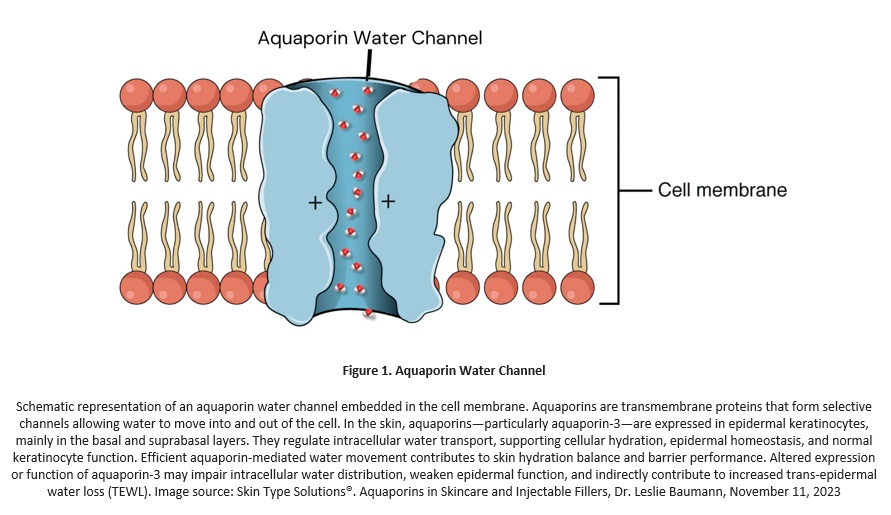
Dehydration occurs when water loss exceeds the skin’s capacity to retain and redistribute water. At the surface, the stratum corneum regulates hydration through its barrier structure. Intercellular lipids and natural moisturizing factors bind water and limit evaporation, maintaining low and stable TEWL. Within the epidermis, keratinocytes regulate intracellular and intercellular water balance, supported by aquaporins—specialized membrane channels that facilitate controlled water movement according to cellular needs.
This regulation supports cellular function, differentiation, and continuous barrier renewal. At the dermal level, the extracellular matrix, rich in hyaluronic acid, provides a continuous water supply that supports epidermal hydration and tissue elasticity. When barrier integrity, epidermal water regulation, or dermal water availability is reduced—such as with aging or environmental stress—TEWL increases, water retention declines, and dehydration develops. For this reason, TEWL is a key indicator of functional skin hydration and barrier competence.
TRIGGERS THAT ELEVATE TRANSEPIDERMAL WATER LOSS
Trans-epidermal water loss (TEWL) increases when factors that weaken the skin barrier disrupt the normal hydration balance. The process begins at the surface, where damage to the stratum corneum reduces intercellular lipids and natural moisturizing factors, making the barrier more permeable and increasing passive water evaporation. As water loss rises, the deeper layers of the epidermis are affected.
Keratinocytes respond with a short-term compensatory increase in metabolic activity and turnover to maintain intracellular hydration. This response is not restorative: it increases cellular stress and results in a less organized and less effective barrier, further promoting TEWL. When epidermal water transport mechanisms, particularly aquaporin-mediated pathways, become inefficient, water distribution within skin cells is impaired. Cellular hydration declines, barrier repair slows, and elevated TEWL persists.
With ongoing imbalance, the dermis becomes involved. Reduced hydration of the extracellular matrix—especially lower hyaluronic acid levels—limits the dermis’s capacity to store and supply water to the epidermis. This weakens epidermal recovery and reinforces dehydration across all skin layers. External and internal stressors such as aging, UV exposure, inflammation, pollution, low humidity, and hormonal changes accelerate this cascade, leading to persistent trans-epidermal water loss and progressive skin dehydration.
AGE-RELATED CHANGES IN TRANSEPIDERMAL WATER LOSS REGULATION MENTATION
In young skin, trans-epidermal water loss (TEWL) is efficiently regulated through rapid barrier repair, effective water redistribution across epidermal layers, and flexible hydration control. Transient increases in water loss are quickly compensated. With progressive aging, this regulatory capacity gradually declines. Lipid synthesis slows, natural moisturizing factors decrease, cellular metabolism becomes less efficient, and epidermal water transport mechanisms are reduced. As a result, the skin’s ability to recover from water loss diminishes, and TEWL becomes more persistent over time.
Environmental stressors such as UV exposure, low or high humidity, pollution, and inflammation further burden this already weakened system. Aging skin is therefore characterized not simply by increased water loss, but by a reduced biological capacity to regulate, recover, and stabilize hydration.
ADDRESSING TRANSEPIDERMAL WATER LOSS TO RESTORE AND STABILIZE SKIN HYDRATION
Management of elevated trans-epidermal water loss (TEWL) requires treatments that restore hydration, preserve barrier integrity, and support skin function without causing additional stress or side effects. This is particularly relevant in skin with impaired barrier function, often associated with dehydration, sensitivity, reactivity, discomfort, and reduced resilience. To meet these needs, the non-invasive, contact-and needle-free approach of JetPeel by TavTech supports skin function while preserving epidermal barrier integrity.
Its treatment cycle addresses multiple aspects of compromised skin. It supports microcirculation, helping improve oxygen and nutrient availability important for recovery and vitality. Lymphatic stimulation may assist fluid balance and reduce visible congestion. Gentle exfoliation promotes epidermal renewal, smoother texture, and radiance while respecting barrier integrity.
According to specific skin conditions, JetCare by TavTech serums can be delivered efficiently to support hydration recovery, reinforce the skin barrier, improve skin comfort, restore functional balance, and support skin rejuvenation. By integrating this advanced non-invasive approach with tailored JetCare formulations, JetPeel by TavTech represents an effective strategy to improve resilience, healthier appearance, and long-term rejuvenation in TEWL-associated skin conditions.
CONCLUSION
Skin hydration depends on adequate water content, barrier integrity, and normal repair function. When impaired, dehydration and elevated trans-epidermal water loss (TEWL) may occur. Effective management should target TEWL at different skin functional levels, not hydration alone.
The needle-free, contact-free approach of JetPeel by TavTech can support key skin functions, including microcirculation, epidermal renewal, hydration, and skin structure. Combined with targeted JetCare formulations, it supports barrier recovery and healthier, more resilient skin.
