

THE SKIN BIOME AND CUTANEOUS HOMEOSTASIS
Laura Masini, JetPeel by TavTech Global Educator
ABSTRACT
The skin biome, also known as the cutaneous microbiome, is the community of microorganisms that naturally live on the surface of the skin. These microorganisms are an active part of skin physiology. They constantly interact with the skin barrier, the immune system, and the chemical environment of the skin surface. Through this continuous interaction, they help maintain cutaneous homeostasis, which is the skin’s ability to remain stable while adapting to internal and external stress.
When the skin biome is balanced, it supports the integrity of the skin barrier, helps maintain a physiological skin surface pH, and contributes to controlled inflammatory responses. These mechanisms are essential for skin resilience and long-term functional balance. When the microbial balance or skin surface pH is altered, the skin may become more sensitive, recover more slowly, and gradually lose functional efficiency. Understanding the relationship between the skin biome, pH, and homeostasis is essential for interpreting how the skin behaves and for approaching skin treatments in a way that respects physiology and supports long-term skin quality.
INTRODUCTION
Skin quality can be described as the skin’s ability to maintain balance while continuously adapting to internal and external challenges. This balance, referred to as cutaneous homeostasis, depends on the integrity of the stratum corneum barrier, proper hydration, controlled inflammation, and stable surface chemistry.
Two key regulators of skin surface function are skin pH and the cutaneous microbiome. When these systems are preserved, the skin tends to tolerate treatments better, recover more quickly, and remain resilient over time. When they are repeatedly disrupted, barrier repair slows down and the skin may become dry, sensitive, and reactive.
THE SKIN BIOME AND SKIN HOMEOSTASIS
The skin biome (cutaneous microbiome) is the community of microorganisms—including bacteria, fungi, viruses, and mites—that inhabit the skin surface and superficial structures. In healthy skin, these organisms coexist with the host in a dynamic equilibrium and contribute to colonization resistance against pathogens, immune modulation, and metabolic activities that influence the skin surface environment.
Microbial composition varies by body site, sebum and sweat levels, humidity, age, and skincare habits. Importantly, the microbiome is not a fixed “fingerprint”: it is generally resilient but can shift with environmental change, inflammation, antimicrobial exposure, or barrier disruption. For long-term skin health and aging management, the goal is not to eliminate microbes, but to preserve or restore a balanced ecosystem in the context of an intact barrier.
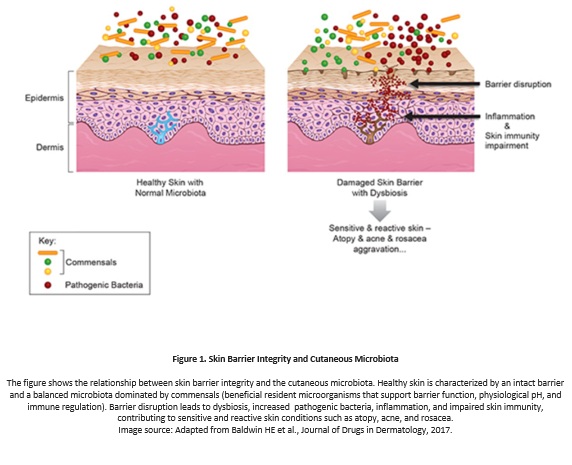
SKIN PH AND THE SKIN BIOME
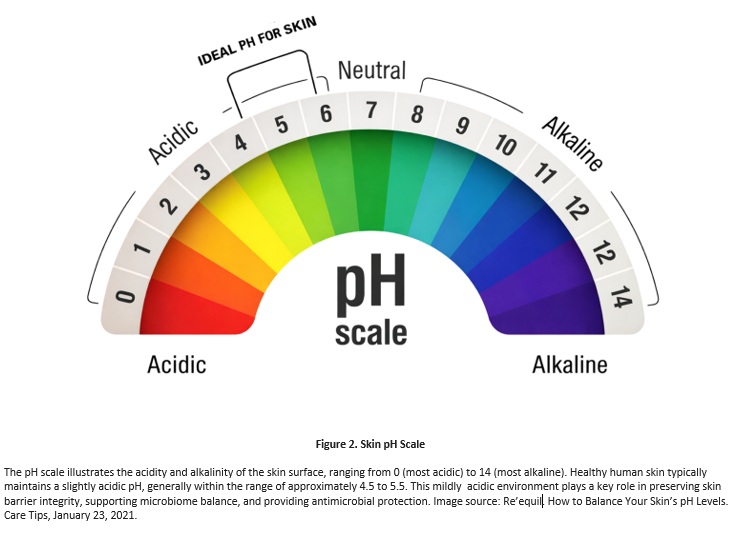
Skin surface pH and the cutaneous microbiome are tightly interrelated. Healthy adult skin is typically mildly acidic, most commonly around pH 4.5–5.5, although values vary by anatomical site, age, sebum and sweat production, climate, cleansing routines, and measurement technique. This mild acidity supports key enzymatic processes involved in barrier maturation (including lipid processing in the stratum corneum), helps regulate desquamation, and limits the growth of many potential pathogens.
Surface pH also shapes microbial ecology by favoring acid-adapted commensals; in turn, microbial metabolism can contribute to surface acidity through the production of organic acids and other metabolites. When surface pH increases (for example after repeated exposure to alkaline products or in the setting of barrier impairment), barrier recovery may be less efficient and microbial balance may shift, which can increase the risk of irritation or inflammation—especially in predisposed individuals.
THE HYDROLIPIDIC FILM IN SKIN BIOME AND CUTANEOUS HOMEOSTASIS
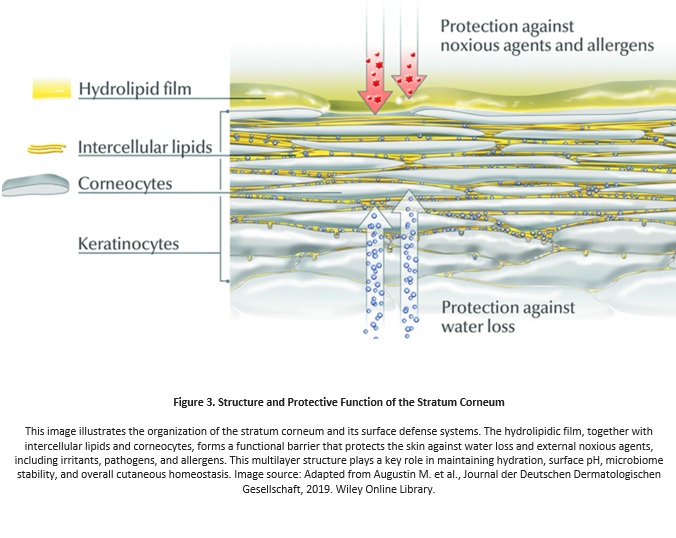
The relationship between pH, the skin biome, and cutaneous homeostasis is most evident at the level of the stratum corneum and the skin surface film, commonly called the hydrolipidic film or acid mantle. This surface film is made of sebum-derived lipids, sweat components, lipids from corneocytes, and microbial metabolites. Together, these elements help regulate lubrication, surface chemistry, and antimicrobial defense.
Hydration of the stratum corneum is maintained mainly inside the corneocytes through water-binding substances known as the Natural Moisturizing Factor, which is largely derived from filaggrin breakdown (filaggrin is a structural protein of the skin that, when broken down, produces molecules that help retain water), and through intercellular lipids that reduce transepidermal water loss. When this organization is disrupted, water loss increases, surface pH may rise, and the skin biome can become less stable. As a result, irritation may increase and skin recovery after treatments may slow down.
PRESERVING SKIN FUNCTION IN CONTEMPORARY AESTHETIC MEDICINE
Contemporary aesthetic medicine is increasingly focused on preserving skin function over time rather than pursuing aggressive correction. This shift reflects a deeper understanding of skin physiology and surface regulation, recognizing that long-term skin quality depends on the preservation of cutaneous homeostasis rather than forced change. In cutaneous homeostasis, skin surface pH—physiologically maintained in humans within a mildly acidic range—constitutes the first and primary regulatory parameter, as it directly governs barrier enzyme activity, hydrolipidic film integrity, and skin biome stability. Disruption of this balance, particularly toward alkalinization, compromises barrier recovery and promotes biome destabilization, increasing the risk of sensitivity and inflammatory imbalance.
JetPeel by TavTech represents a non-invasive, skin-preserving approach that respects skin physiology and surface regulation. In particular, the JetCare by TavTech products used in combination with the JetPeel system play a central functional role in supporting a balanced, healthy, and correct skin surface pH, which is essential for maintaining the skin biome and cutaneous homeostasis. Formulated to remain within skin-physiological pH ranges across all four treatment stages, JetCare Hydro, used during lymphatic massage, and JetCare Renewal Care, employed during exfoliation, are especially critical, as they protect the acid mantle during the most pH-sensitive phases of treatment.
During the infusion and booster stages, targeted products from JetCare Anti-Aging Care, JetCare Selective Care, and JetCare Boost maintain pH compatibility, reinforcing barrier integrity and microbiome equilibrium while supporting skin quality and rejuvenation. By preserving surface balance and limiting inflammatory stress, visible improvement can be achieved without compromising skin biome stability or cutaneous homeostasis, resulting in outcomes that are effective, well tolerated, and consistent over time.
CONCLUSION
Skin surface pH, the skin biome, and the hydrolipidic film are fundamental regulators of cutaneous homeostasis. They strongly influence how the skin responds to treatments, environmental stress, and aging. When this balance is preserved, skin reactions remain controlled and outcomes are more consistent and predictable. Preserving skin function is therefore essential for achieving effective, safe, and long-lasting aesthetic results.
