
PHOTOAGING: UV-INDUCED STRUCTURAL AND CELLULAR DAMAGE IN THE SKIN
Laura Masini, JetPeel by TavTech Global Educator
ABSTRACT
Photoaging is the premature and cumulative skin damage caused by chronic exposure to light. Ultraviolet radiation is the primary external factor accelerating skin aging. Unlike intrinsic aging, photoaging results from ongoing environmental stress and leads to characteristic structural, cellular, and functional alterations.
With repeated exposure, UVA, UVB, and partly visible light induce progressive photodamage through DNA damage affecting skin cells, oxidative stress, persistent inflammation, and degradation of the extracellular matrix, particularly collagen and elastin. Understanding these mechanisms is essential in aesthetic medicine for effective prevention, accurate risk assessment, and targeted treatment.
INTRODUCTION
Skin does not age only with time; it ages with exposure. While intrinsic aging follows a natural biological course, chronic light exposure gradually reshapes the skin at a cellular and structural level, often long before visible signs appear. These changes become most evident in sun-exposed areas, where firmness, elasticity, uniformity, and regenerative capacity progressively decline.
Skin photodamage remains one of the most prevalent and persistent clinical concerns. A substantial proportion of visible skin aging — including wrinkles, laxity, and pigmentary changes — is attributed to chronic UV-induced damage rather than intrinsic aging alone. This makes photoaging a central focus for patients seeking to restore skin quality and for clinicians aiming to achieve safe, effective, and lasting outcomes.
INTERACTION OF ULTRAVIOLET RADIATION WITH SKIN CELLS
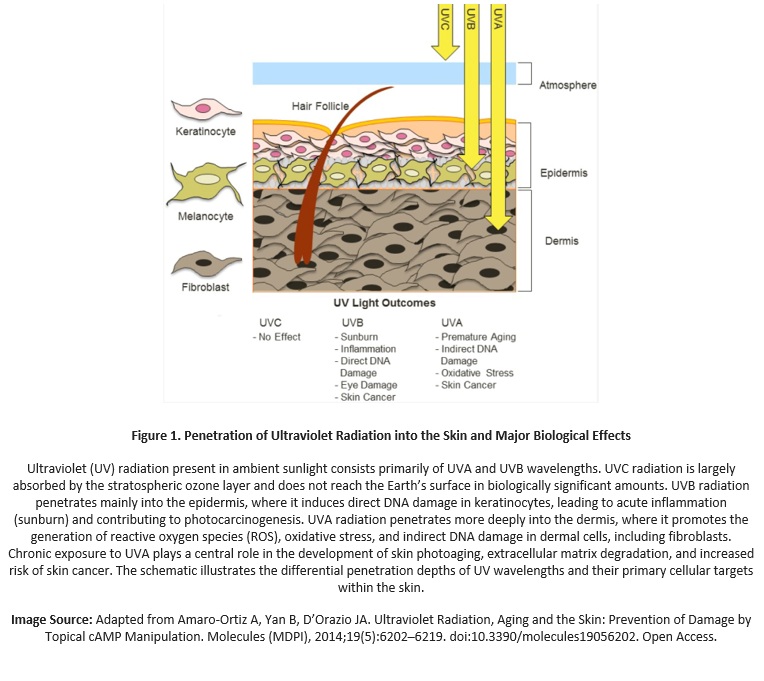
Ultraviolet radiation penetrates the skin and damages skin cells by directly damaging DNA and by generating free radicals, which cause mutations, inflammation, and premature skin aging (photoaging). UVB radiation acts mainly on the epidermis, where it directly damages keratinocyte DNA, leading to sunburn and disruption of the skin barrier. UVA radiation penetrates deeper into the skin and reaches the dermis, where it damages skin cells and structural components and contributes to photoaging. In the dermis, UVA radiation induces oxidative stress, reduces collagen synthesis, and is associated with apoptosis (cell death of fibroblasts), in fibroblasts, the main dermal cells responsible for producing collagen and elastin.
Damage to fibroblasts leads to loss of dermal structure, skin sagging, and wrinkle formation. In addition, UVA radiation damages the vascular system within the skin, leading to reduced blood flow and reduced delivery of oxygen and nutrients, and weakens immune defences in the dermis, reducing the skin’s ability to respond effectively to damage and further contributing to structural and functional deterioration of the skin.
MECHANISMS OF UV-INDUCED OXIDATIVE STRESS IN THE SKIN
UV radiation causes oxidative stress in the skin by damaging cells through two main mechanisms. It can directly damage DNA and it increases the formation of highly reactive oxygen molecules, called reactive oxygen species (ROS), which are involved in oxidative stress.
These molecules can damage DNA, proteins, and lipids and may exceed the skin’s natural antioxidant defences, leading to cellular dysfunction. During UV exposure, particularly from UVA and UVB, molecules within skin cells absorb UV energy and promote the generation of ROS. When this process continues during exposure, oxidative stress in the skin becomes sustained.
UV-INDUCED SKIN INFLAMMATION
Ultraviolet (UV) radiation induces a strong inflammatory response in the skin. Initially, this response is acute and protective, appearing as sunburn. With repeated exposure, inflammation becomes persistent and pathological, driving premature skin aging and skin cancer development (photo-carcinogenesis). UV damage is driven by direct DNA injury and high oxidative stress, which disrupt normal cellular control and overwhelm the skin’s anti-inflammatory defences.
STRUCTURAL CHANGES IN PHOTO-AGED SKIN
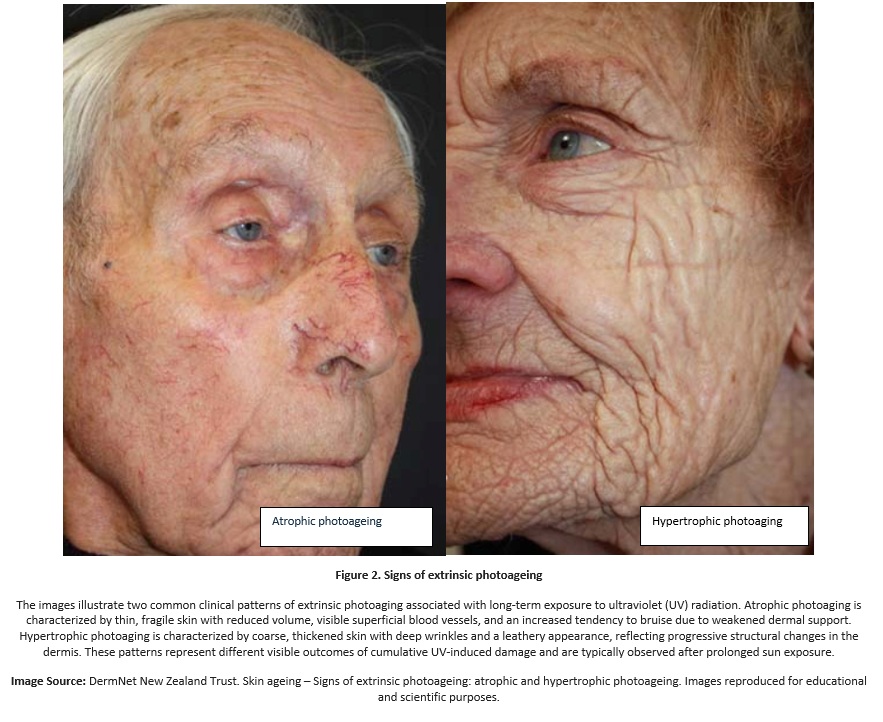
Repeated UV exposure leads to characteristic structural alterations in both the epidermis and dermis. The epidermis becomes uneven and less efficient as a protective barrier, while the dermis undergoes profound matrix remodelling. Collagen fibres become fragmented, elastin accumulates in abnormal forms, and normal dermal architecture is progressively lost.
Vascular alterations reduce efficient oxygen and nutrient delivery, further limiting tissue vitality and repair. These cumulative changes explain the loss of firmness, elasticity, and resilience that define clinically photoaged skin. Photo-aged skin is structurally weakened and has reduced repair capacity; treatment approaches often need to be carefully selected and tailored to avoid further damage.
MANAGEMENT OF PHOTO-AGED SKIN AS A COMPROMISED TISSUE
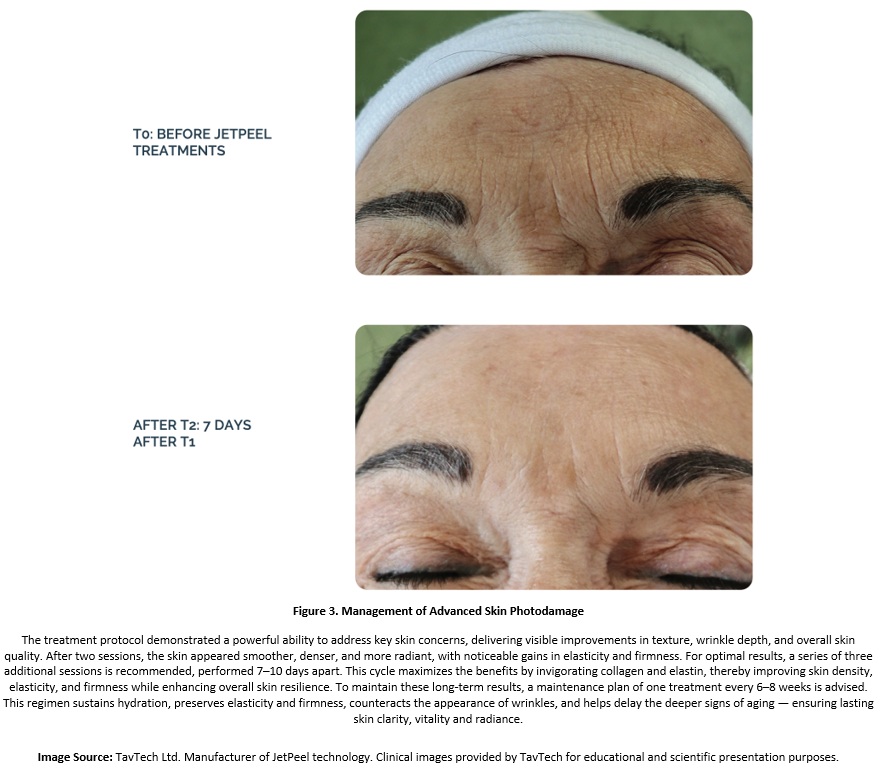
In compromised, photo-aged skin, supportive treatments should aim to improve tissue conditions without adding mechanical or inflammatory stress. JetPeel by TavTech treatment, with its multi-dimensional skin approach, can support microcirculation, helping to optimize oxygen and nutrient availability in weakened tissue and creating a more favourable environment for repair.
The contact-free exfoliation step allows the removal of superficial corneocyte buildup and supports cell renewal, which is particularly important in photo-aged skin where chronic UV exposure slows the natural regeneration cycle. This process occurs without friction or barrier disruption, making it suitable for fragile or compromised skin conditions. Non-contact trans-epidermal infusion delivers targeted ingredients without needles or additional trauma, supporting skin structure and function. For moderate photo-aged or reactive skin, JetCare Selective Care Soothing formulations may be infused to help reduce redness and support barrier recovery.
Antioxidant-rich formulations such as JetCare Boost Regenerate, enriched with vitamins A and E, may be alternated with JetCare Boost Glow, enriched with vitamin C, during the booster infusion stage to further support antioxidant balance and overall skin vitality. In more advanced or highly compromised photo-aged skin, targeted multi-component formulations such as JetCare Med by TavTech may be infused to invigorate collagen and elastin and to improve skin density, elasticity, and firmness, as part of a gradual and biology-driven management strategy with clinically proven results. Effective management of photo-aged skin requires a carefully tailored, non-aggressive approach that supports skin function, resilience, and long-term tissue health.
CONCLUSION
Photo-aged skin is a structurally and functionally compromised tissue with reduced regenerative capacity. Effective management therefore requires non-aggressive, biology-driven strategies that support microcirculation, barrier integrity, antioxidant balance, and gradual tissue recovery.
JetPeel by TavTech offers a non-invasive, contact-free approach that can assist these goals by improving tissue conditions, enabling gentle exfoliation, and facilitating targeted trans-epidermal infusion—making it a supportive option within a comprehensive, carefully tailored photo-aging management strategy.
