
OXIDATIVE STRESS AND ITS IMPACT ON SKIN QUALITY
Laura Masini, JetPeel by TavTech Global Educator
ABSTRACT
Oxidative stress is a key biological mechanism influencing skin aging and the progressive decline of skin quality. It results from an imbalance between the production of reactive oxygen species (ROS), a group of highly reactive molecules that includes free radicals, and the skin’s antioxidant defense systems.
While controlled oxidative activity is essential for normal cellular metabolism and signaling, excessive or chronic oxidative stress leads to structural and functional damage. This process disrupts cellular integrity, barrier function, extracellular matrix organization, and regenerative capacity, accelerating visible aging and increasing vulnerability to environmental and internal stressors.
INTRODUCTION
Skin quality reflects the skin’s ability to maintain structural integrity, functional performance, and physiological stability over time. The skin is continuously challenged by processes that affect its balance, while aging progressively reduces its regenerative and adaptive capacity.
Oxidative stress has a strong and cumulative impact on skin quality, influencing the skin’s ability to preserve function and structure over time. For this reason, preserving skin quality by supporting physiological balance represents a central strategy at all ages and becomes increasingly important as aging progresses, providing the foundation for long-term skin health.
BIOLOGICAL MECHANISMS OF OXIDATIVE STRESS IN THE SKIN
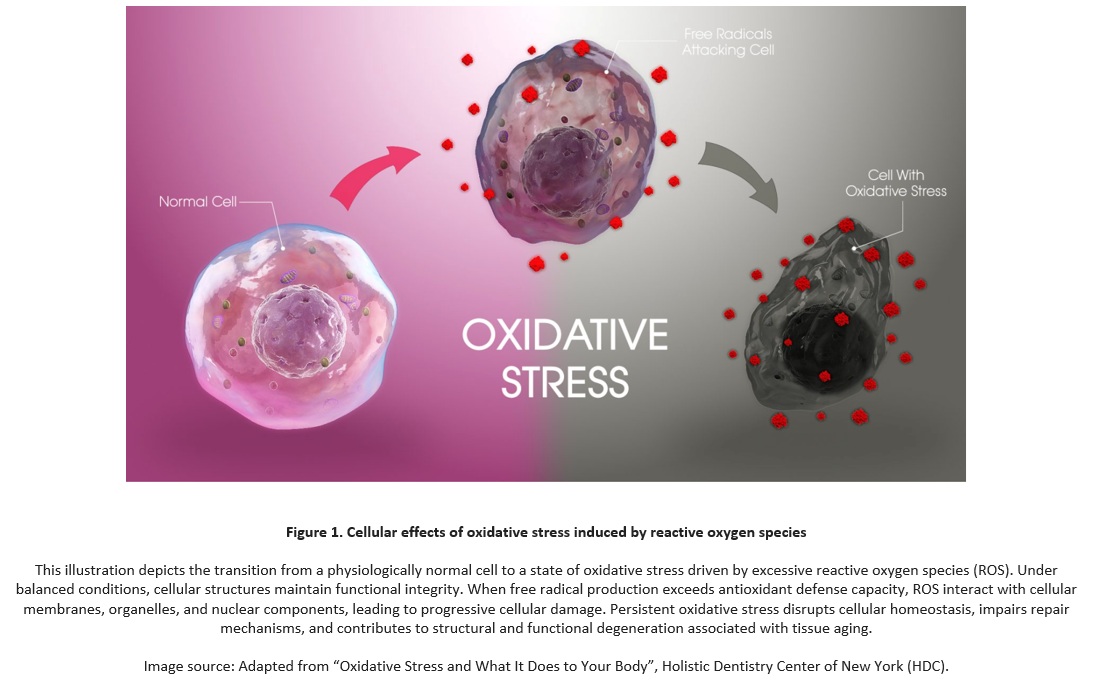
Oxidative stress arises from an imbalance between the production of reactive oxygen species (ROS) and the skin’s antioxidant defense capacity. ROS include both free radicals (molecules with an unpaired electron) and non-radical reactive species, which are continuously generated during normal cellular metabolism and play physiological roles when tightly regulated. Oxidative stress develops when ROS production increases or when antioxidant defenses decline, a process commonly associated with ultraviolet exposure, environmental pollution, inflammation, metabolic stress, and aging. With advancing age, antioxidant reserves progressively decrease, reducing the skin’s ability to neutralize excess ROS.
When present in excess, ROS damage lipids, proteins, and DNA. In the epidermis, this results in impaired keratinocyte function, barrier weakening, and increased transepidermal water loss. In the dermis, oxidative stress contributes to collagen and elastin degradation and to altered hyaluronic acid turnover, leading to reduced structural support and tissue resilience. If sustained, oxidative stress promotes chronic low-grade inflammation, impairs cellular repair mechanisms, and drives progressive structural deterioration. Over time, these alterations accelerate skin aging, compromise tissue function, and reduce the skin’s capacity to maintain physiological homeostasis.
HOW TO RECOGNIZE OXIDATIVE STRESS IN THE SKIN AND WHY IT MATTERS CLINICALLY
Oxidative stress in the skin is not defined by a single visible sign but by functional impairment. Clinically, it presents as reduced brightness, uneven tone, increased sensitivity, delayed recovery, dryness, and accelerated loss of elasticity. Biologically, these changes reflect reduced antioxidant capacity, impaired barrier renewal, decreased fibroblast functional activity, and inefficient repair mechanisms.
The skin becomes structurally weaker and less resilient. Recognizing oxidative stress is essential, as aggressive interventions may worsen damage. Clinical management should prioritize protective and restorative strategies that reduce oxidative burden, support barrier integrity, preserve hydration, and modulate inflammation.
OXIDATIVE STRESS, INFLAMMAGING, AND SKIN REACTIVITY
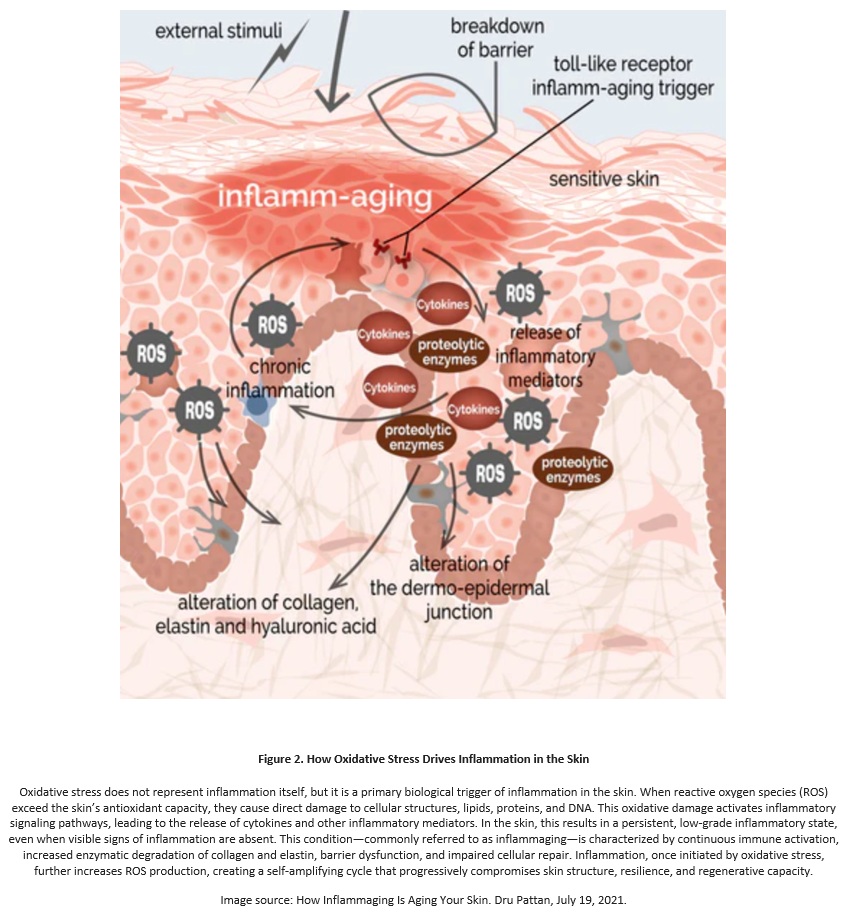
Oxidative stress is one of the primary biological triggers of inflammation (inflammaging), which further amplifies the degenerative processes already initiated within skin structures. This self-reinforcing interaction progressively compromises skin homeostasis and key functions, including barrier integrity, hydration balance, cellular renewal, and structural support.
Clinically, skin under chronic oxidative and inflammatory burden becomes fragile, reactive, and less capable of effective self-regulation, even in the absence of visible inflammatory signs. From a clinical management perspective, this condition requires modulation and restoration of skin balance, not aggressive stimulation. A non-invasive, multi-target approach is therefore essential to reduce oxidative and inflammatory burden and support gradual recovery of skin function over time.
PROGRESSIVE LOSS OF SKIN RESILIENCE AND REGENERATIVE CAPACITY
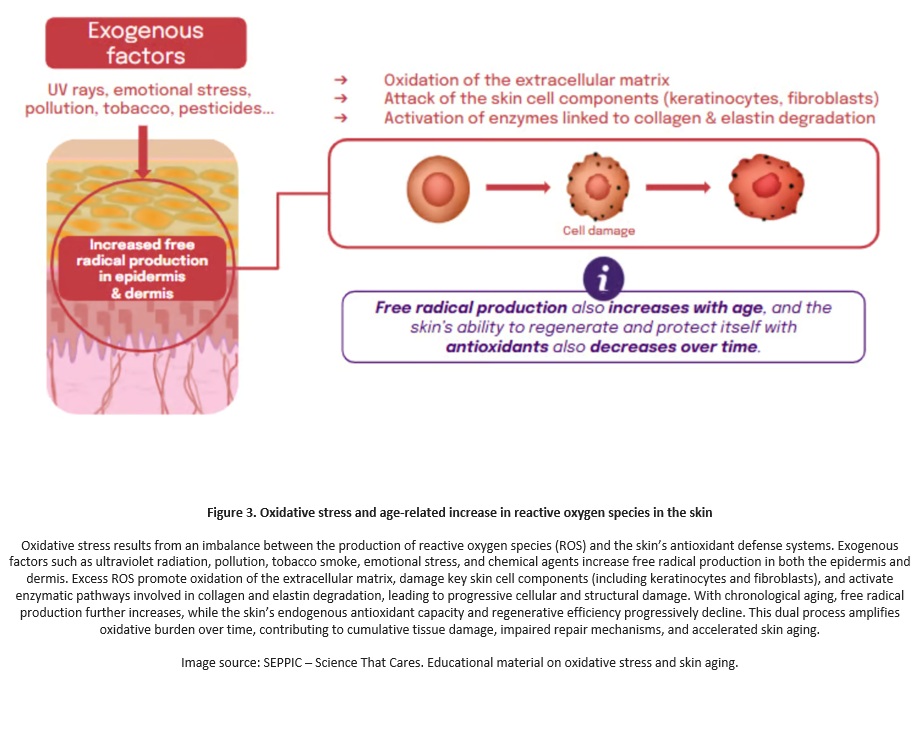
The cumulative burden of oxidative stress and chronic low-grade inflammation, together with chronological aging, leads to a progressive loss of skin resilience and regenerative efficiency. Over time, the skin becomes increasingly vulnerable and less capable of maintaining functional balance.
With aging, oxidative burden progressively increases due to reduced efficiency in reactive oxygen species (ROS) control, while endogenous antioxidant defense systems and regenerative capacity gradually decline, further amplifying functional impairment. Current aesthetic strategies increasingly focus on preserving skin resilience rather than intensifying corrective stimulation. Clinical management should therefore support regeneration, modulate chronic inflammation, and preserve skin function through non-invasive, long-term restorative approaches.
CLINICAL MANAGEMENT OF OXIDATIVE STRESS-RELATED SKIN FUNCTIONAL DECLINE
In oxidative stress–related skin functional decline, clinical management must prioritize non-invasive, multidimensional strategies that preserve skin physiology without introducing additional biological burden. As skin resilience and regenerative capacity progressively decline, interventions should operate through modulatory and supportive mechanisms, addressing multiple impaired functions in a coordinated manner. JetPeel by TavTech is a non-invasive, needle-free procedure based on a multidimensional trans-epidermal delivery approach, developed to support skin function while fully respecting tissue integrity.
The system promotes microcirculatory and lymphatic support, together with controlled exfoliation and regenerative renewal, without disrupting the epidermal barrier. It enables selective infusion of functional ingredients, chosen according to predominant degenerative skin features. Protocols include JetCare Anti-Aging Care which supports skin homeostasis and structure.
JetCare Med which invigorates collagen and elastin, with clinically proven outcomes in improving skin density, firmness, and elasticity. JetCare Boost provides wide-spectrum antioxidant support, contributing to the modulation of oxidative burden. JetPeel by TavTech treatment may be performed in combination with red LED photo biomodulation (620–630 nm), acting simultaneously to mitigate oxidative stress while supporting regenerative activity. This combined approach contributes to skin rejuvenation by improving texture, and elasticity, without adding inflammatory or biological burden.
CONCLUSION
The accumulation of oxidative stress, chronic low-grade inflammation, and chronological aging leads to a progressive decline in skin resilience and regenerative capacity. Addressing this condition requires restorative, non-invasive strategies that support regeneration, and preserve skin function over time.
JetPeel by TavTech fits within this clinical framework as a supportive, multidimensional approach, contributing to the maintenance of skin quality and functional stability in the context of oxidative stress-related skin aging.
