
INFLAMMAGING: THE SLOW-BURNING INFLAMMATION ACCELERATING SKIN AGING
Laura Masini, JetPeel by TavTech Global Educator
ABSTRACT
Inflammaging refers to a chronic, low-level inflammatory process that develops over time and progressively increases with aging. Unlike acute inflammation, which is rapid and self-limiting, inflammaging is low-grade, persistent, and often clinically silent. Despite its low intensity, this ongoing inflammatory activity gradually disrupts skin homeostasis, affecting barrier integrity, immune balance, cellular metabolism, and extracellular matrix turnover.
As a result, collagen and elastin organization becomes altered, tissue resilience declines, and skin recovery slows. These changes are associated with wrinkles, loss of firmness, uneven pigmentation, increased sensitivity, and delayed skin recovery. Although more evident with advancing age, inflammaging may begin earlier in life as a result of cumulative environmental and intrinsic stressors and can affect all skin types.
INTRODUCTION
Skin aging is a multidimensional process in which multiple biological changes occur simultaneously and progressively over time. Persistent low-grade inflammation influences skin behavior, reducing adaptability and recovery capacity and contributing to visible aging changes.
Skin under chronic inflammatory stress has limited tolerance to additional trauma. Further inflammatory stimulation does not necessarily rejuvenate the skin; it can increase biological stress and may contribute to tissue decline. For this reason, a non-invasive approach is the most coherent strategy to support skin function and long-term stability.
PHYSIOLOGICAL INFLAMMATION
Physiological inflammation is a normal, short-term repair response. It can occur at any age and in all skin types after an acute stimulus. Inflammatory signaling is activated to repair tissue and is then reduced once balance is restored. On the surface, the skin may show mild redness or temporary sensitivity that resolves quickly.
The person usually reports brief warmth, tightness, or discomfort that disappears as the skin recovers (triggers: minor injury, UV exposure, infection, invasive treatments). This state is fully reversible and restores normal skin function. If repeatedly overstimulated, it may shift toward chronic inflammation.
CHRONIC INFLAMMATORY STATE
A chronic inflammatory state may develop when inflammation is repeated or does not fully resolve. Inflammatory signaling remains active longer than necessary, barrier stability may decrease, and recovery may slow. The skin appears reactive, easily irritated, slower to calm, and less tolerant to products or treatments.
The person often reports persistent sensitivity, burning, dryness, or the feeling that the skin never fully recovers (triggers: overly aggressive or frequent aesthetic procedures, barrier disruption, inappropriate skincare, chronic UV exposure, pollution, smoking, stress, hormonal imbalance, certain medications such as retinoids, corticosteroids, or immunomodulators). This state is potentially reversible if inflammatory triggers are reduced and recovery mechanisms are supported. If not addressed, it promotes inflammaging.
INFLAMMAGING
Inflammaging is persistent, low-grade inflammation integrated into baseline skin function, with progressive severity over time, especially if not properly managed. Inflammatory activity is inefficiently resolved, repair efficiency declines, and structural renewal progressively weakens. The skin may not look inflamed, yet firmness and elasticity may decrease and recovery may become consistently slow.
Often describes the skin as fragile, less resilient, easily stressed, and unpredictable (triggers: intrinsic aging, cumulative UV exposure, pollution, oxidative stress, repeated unresolved inflammation, metabolic imbalance, long-term procedural overstimulation). Inflammaging is not fully reversible, but it can be modulated and slowed. If untreated, it progressively accelerates functional aging and limits the skin’s capacity to respond to treatments.
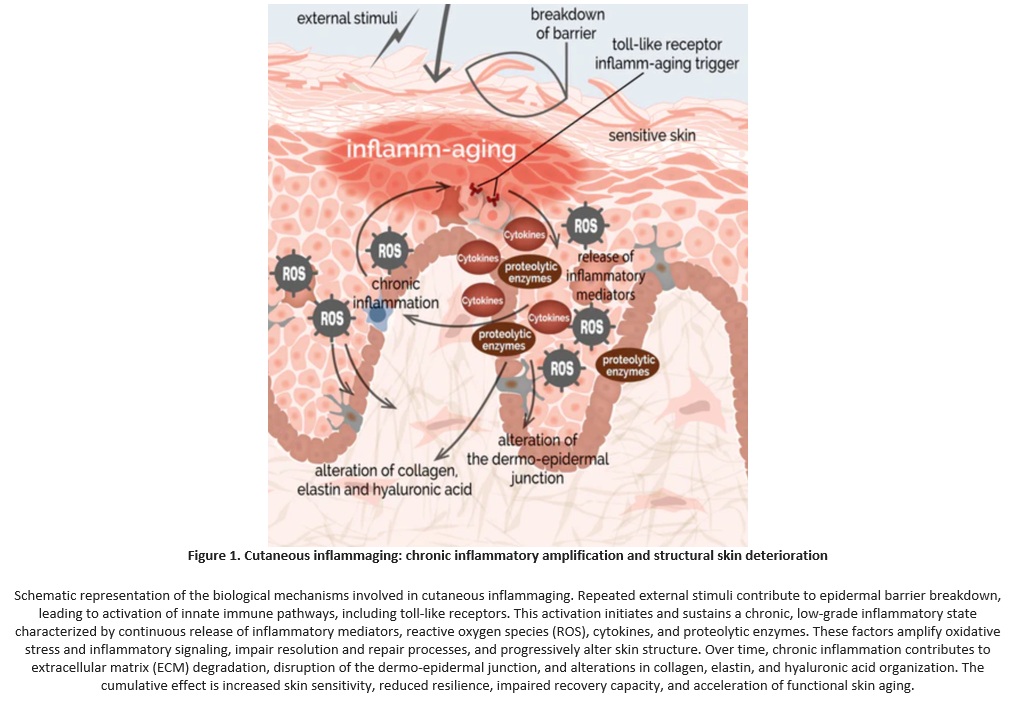
Legend:
External stimuli: Environmental, mechanical, chemical, or procedural factors that challenge skin homeostasis
Breakdown of barrier: Disruption of epidermal barrier integrity, increasing permeability and sensitivity
Toll-like receptor inflammaging trigger: Activation of innate immune receptors involved in inflammatory and immune signaling
Sensitive skin: Skin with reduced tolerance and heightened reactivity due to impaired barrier and chronic inflammation
Chronic inflammation: Persistent, low-grade inflammatory state maintained over time
Release of inflammatory mediators: Continuous production of molecules that sustain inflammatory signaling
Cytokines: Pro-inflammatory signaling proteins that regulate immune and inflammatory responses
ROS (Reactive Oxygen Species): Highly reactive molecules contributing to oxidative stress and cellular damage
Proteolytic enzymes: Enzymes involved in the degradation of extracellular matrix components
ECM breakdown and remodeling: Progressive degradation and disorganization of the extracellular matrix
Alteration of collagen, elastin, and hyaluronic acid: Structural and compositional changes affecting firmness, elasticity, and hydration
Alteration of the dermo-epidermal junction: Structural weakening of the interface between epidermis and dermis, impairing tissue stability
Image Source: Adapted from Bare Your Skin®, “How Inflammaging Is Aging Your Skin,” 2021.
WHERE INFLAMMAGING OCCURS IN THE SKIN
Inflammaging develops when inflammation is not efficiently resolved and instead becomes part of the skin’s everyday biology. It may settle quietly into the tissue and slowly change how the skin functions over time. In the epidermis, keratinocytes may remain under constant stress and stay in a defensive state rather than a regenerative one. Barrier turnover may slow, lipid organization may become less efficient, and the surface may lose cohesion. At the dermal–epidermal junction, persistent inflammation may weaken the structures that anchor and connect the layers.
Communication between epidermis and dermis may become less effective, repair signals may be delayed, and the skin may lose resistance and stability. In the dermis, chronic inflammation can affect both structure and circulation. Blood vessels may remain chronically stimulated, which may contribute to altered microcirculation and less efficient oxygen and nutrient exchange. Resident immune cells may remain continuously active and keep releasing low levels of inflammatory mediators.
This constant inflammatory environment can alter fibroblast behavior: collagen and elastin may be produced with less organization, while matrix-degrading enzymes may remain active because tissue breakdown is continuously stimulated and repair cannot fully complete. Structural proteins may therefore be degraded faster than they are rebuilt, and the extracellular matrix gradually weakens.
WHY ADDRESSING INFLAMMAGING MATTERS
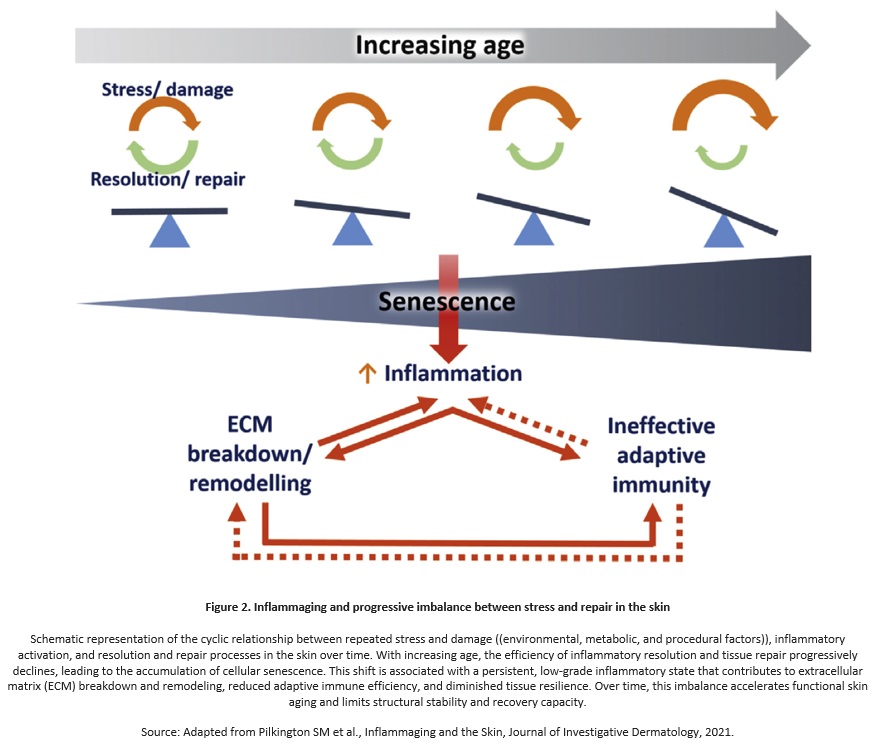
Skin aging is inevitable, but inflammaging represents an additional, potentially modifiable inflammatory burden. Physiological aging is characterized by a gradual decline in regenerative capacity, while chronic low-grade inflammation can shift the balance toward reduced repair efficiency and increased cumulative structural loss. Managing inflammaging does not stop aging, but it can help preserve functional balance, support recovery capacity, and mitigate the pace and depth of long-term tissue deterioration.
HOW TO MANAGE INFLAMMAGING IN THE SKIN
Managing inflammaging is not based on stimulation, but on reducing inflammatory burden, restoring tissue homeostasis, and supporting incomplete repair. In inflammaged skin, biological balance is altered, and the priority is to calm the system before asking it to rebuild. This skin often benefits from decongestion and drainage to reduce fluid stagnation, support microcirculation, and lower inflammatory pressure.
It also requires renewal without inflammation, supporting epidermal turnover while preserving barrier integrity and avoiding additional stress. Repair must remain protective and supportive, reinforcing the barrier and stabilizing tissue structure rather than overstimulating it.
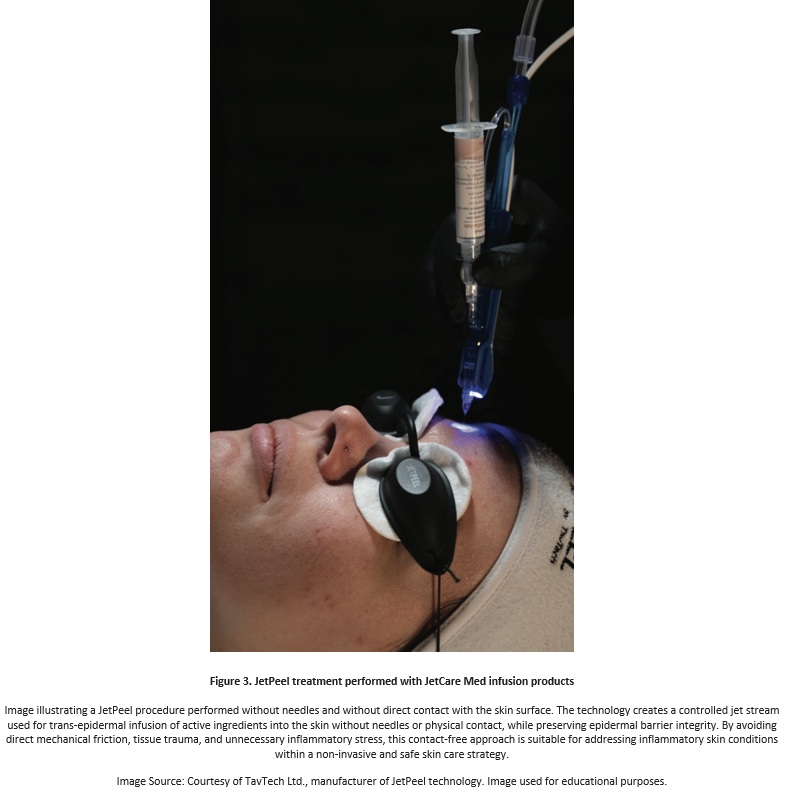
JetPeel by TavTech provides a non-invasive method to combine microcirculation, gentle exfoliation, and active infusion without needles or tissue trauma. When paired with JetCare Med by TavTech infusion products, this approach invigorates collagen and elastin, improves skin density, elasticity, and firmness, and may help limit the progression of chronic inflammation that contributes to tissue degradation and structural decline, supporting skin function over time.
CONCLUSION
In inflammaging, the priority shifts from overstimulation to the reduction of inflammatory load and the preservation of tissue homeostasis. These elements are essential to maintain skin resilience and recovery capacity over time.
JetPeel by TavTech represents a coherent clinical approach by supporting microcirculation, oxygenation, skin renewal, and delivering targeted active ingredients into the skin through a non-invasive trans-epidermal delivery approach, without inducing additional inflammatory stress, thereby supporting skin function and long-term stability.
