THE FOUNDATION OF SKIN CELL REGENERATION
Laura Masini, JetPeel by TavTech Global Educator
ABSTRACT
Cell regeneration refers to the skin’s natural ability to maintain itself by continuously replacing cells, restoring balance, and adapting to daily stress. It does not mean creating new skin or forcing the tissue to rebuild itself. Instead, it describes a set of physiological processes that allow skin cells to function efficiently over time. In the skin, regeneration is mainly the result of two constant activities: renewal and repair. Renewal replaces aging or damaged cells, while repair restores balance when the skin is challenged. When these processes remain efficient and well-coordinated, the skin preserves its structure, resilience, and functional integrity. This long-term capacity is what we define as regenerative potential.
INTRODUCTION
Skin regeneration is often described as a treatment goal in aesthetic medicine. Biologically, however, it is not something that can be created or forced. Regeneration reflects the skin’s intrinsic ability to renew itself, repair daily, and maintain functional balance over time.
These processes are active throughout life and allow the skin to adapt to environmental exposure, mechanical stress, and physiological changes. A clear understanding of how renewal, repair, and regeneration function is essential to support skin health safely and effectively.
EPIDERMAL RENEWAL
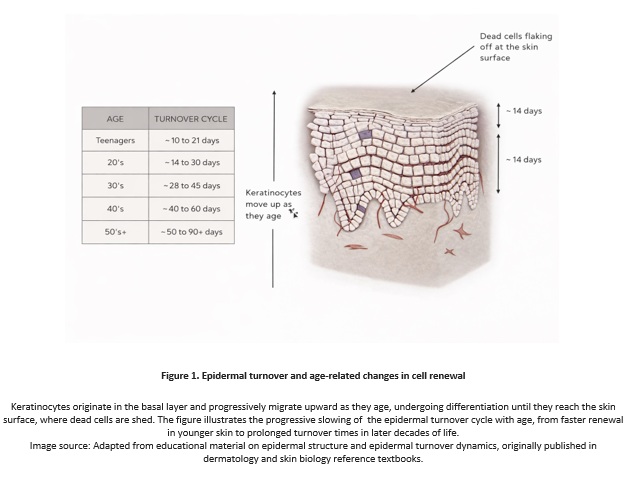
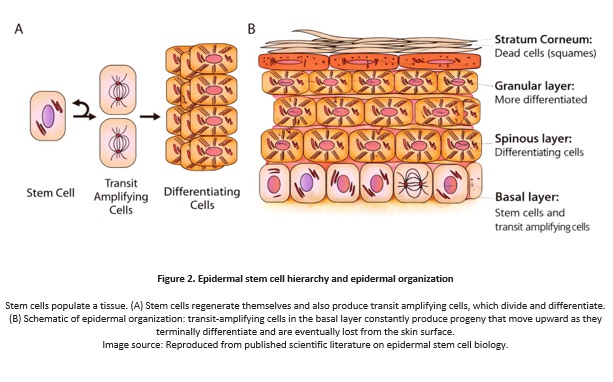
Renewal is the continuous process through which the epidermis replaces its cells. It occurs in the basal layer, where epidermal stem cells ensure long-term renewal capacity and generate progenitor cells responsible for the daily production of new keratinocytes, the main epidermal cells. These keratinocytes migrate upward through the epidermal layers, progressively differentiate, and replace older.
This turnover maintains a compact, functional epidermis and plays a key role in preserving an effective skin barrier. In healthy adult skin, epidermal turnover occurs approximately every 28–40 days. With aging and cumulative biological stress, this cycle progressively slows to 40–60 days and, in some individuals, may reach 70-90 days. As renewal slows, dead cells accumulate on the surface, leading to a thicker stratum corneum, uneven texture, and reduced radiance.
SKIN REPAIR
Repair is the skin’s ability to restore balance after stress or damage. This process is continuously active at a baseline level, while its depth and intensity vary depending on the type and duration of the challenge. A first level of repair can be described as continuous or daily repair and primarily involves the epidermis and the skin barrier. Minor stresses such as friction, dehydration, and environmental exposure regularly disrupt barrier integrity. In response, keratinocytes, epidermal lipids, and cell junctions act together to restore hydration, cohesion, and protection, maintaining skin stability.
When stress is more intense or prolonged, repair responses become deeper and more complex. Cellular communication increases through growth factors and cytokines (cell signaling molecules involved in inflammation and immune regulation) , and fibroblasts become more active, supporting extracellular matrix maintenance and tissue adaptation. Immune cells remove damaged components, inflammation remains regulated, and fibroblasts participate in tissue reconstruction. An intact skin barrier is central to efficient repair. When barrier integrity is preserved, repair remains controlled and effective. When disruption is frequent or chronic, repair may become incomplete, leading to a progressive decline in long-term regenerative capacity.
REGENERATION
Regeneration is the skin’s long-term ability to function efficiently over time. It is not a treatment outcome, not a visible reaction, and not a short-term effect. Renewal is the continuous replacement of skin cells. Repair is the response activated when the skin is stressed or damaged.
Regeneration is the capacity of the skin to continue performing renewal and repair without losing biological balance, tolerance, or functionality. When this internal communication remains balanced, the skin maintains resilience and adaptability. Regeneration is progressively compromised when the skin is repeatedly overstressed.
Chronic inflammation, repeated disruption of the epidermal barrier, and excessive stimulation without adequate recovery time force the skin into a constant state of repair. In this condition, the skin may still react, but its ability to recover and adapt over time is reduced. Visible reactions should not be confused with biological effectiveness. Redness does not indicate regeneration. Peeling does not necessarily reflect renewal. Strong or persistent reactions do not represent healthy skin function. Preserving regeneration means minimizing unnecessary inflammation, maintaining barrier integrity, respecting biological recovery times, and avoiding repeated stimulation that exceeds the skin’s adaptive capacity.
REGENERATION IN MEDICAL AESTHETIC PRACTICE
In aesthetic medicine, regeneration should be supported rather than induced. Excessive stimulation increases inflammation, disrupts physiological repair processes, and accelerates functional decline, particularly in compromised skin.
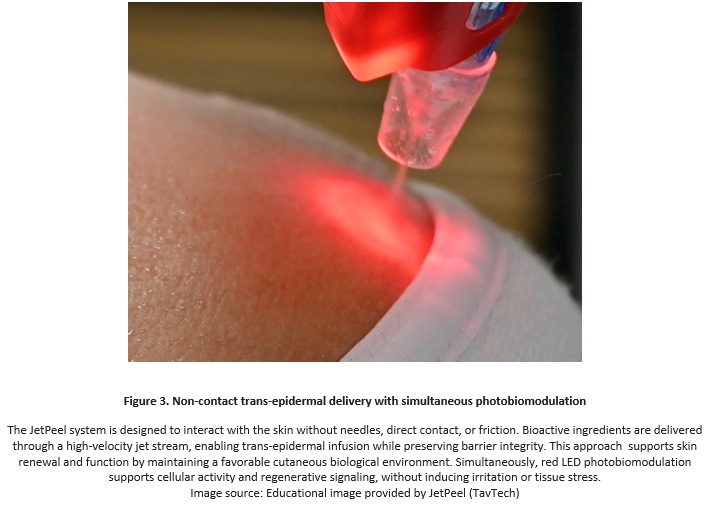
Preserving regenerative capacity requires non-invasive, skin-respectful approaches that allow renewal and repair to occur without sustained biological stress. Technologies such as JetPeel by tavTech, which operate without needles or direct skin contact, can support this process by enabling gentle, non-peeling exfoliation and trans-epidermal delivery of ingredients that support skin function, while preserving barrier integrity. Regeneration is not a treatment outcome, but a criterion for maintaining long-term skin function and stability.
CONCLUSION
Skin cell regeneration is not a single intervention, but the result of a balanced biological system. Adequate circulation, efficient waste removal, preserved barrier function, controlled renewal, and targeted biochemical support that form the foundation of healthy skin regeneration.
True rejuvenation is achieved not by inducing damage, but by respecting skin physiology and supporting the mechanisms that allow the skin to regenerate itself over time.